Chapter 3 · 39 sūtras
The Lower and Middle Worlds
Adhaḥ-loka Madhya-loka Adhyāya
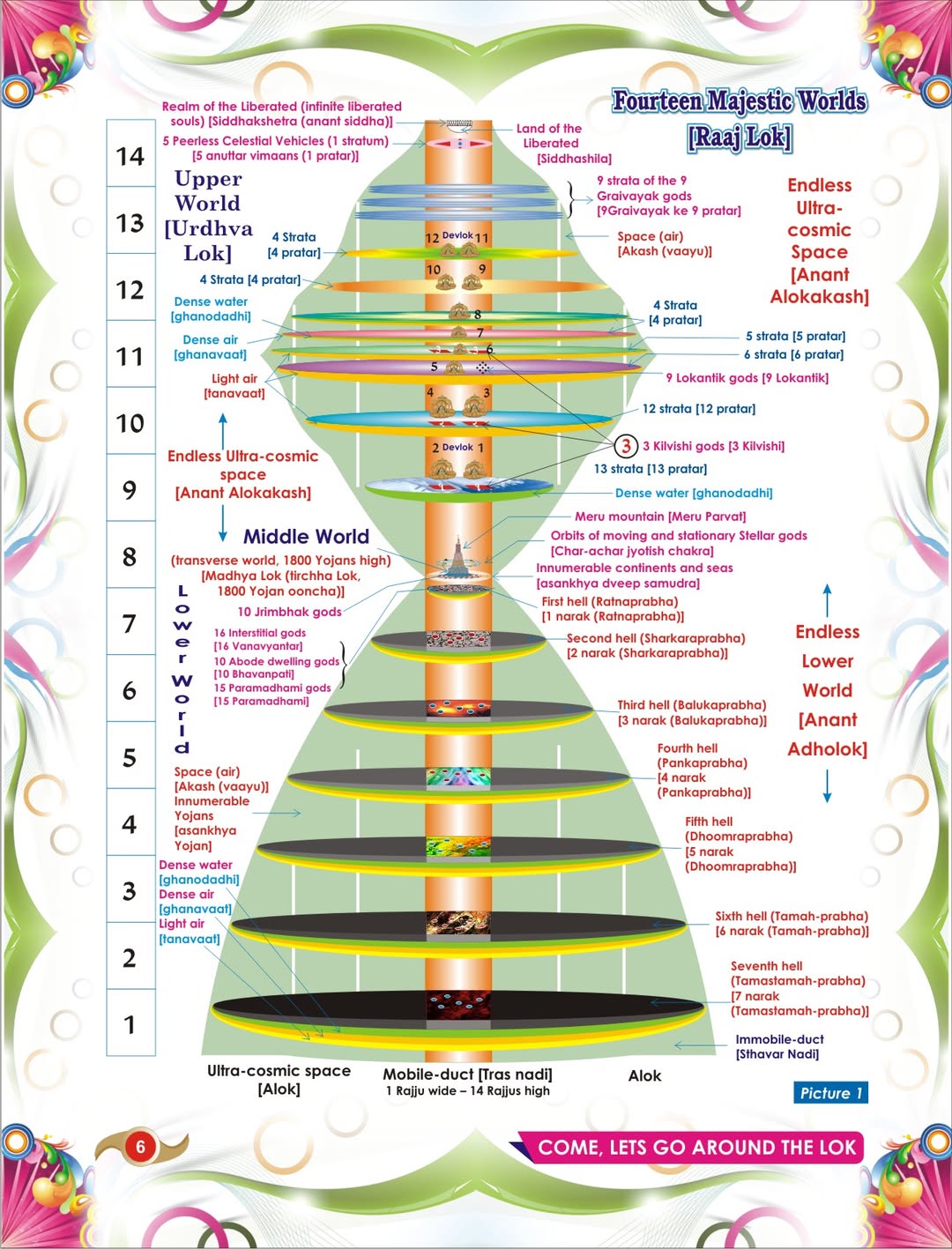
The third chapter maps the lower and middle regions of the occupied universe. Below are seven earths, each hotter or colder, darker and more painful than the last, with a decreasing number of hell-dwellings and increasing lifespans of suffering. Above them lies the middle world: innumerable concentric island-continents and oceans, at whose centre is Jambūdvīpa with Mount Meru. The chapter defines the seven regions of Jambūdvīpa, their dividing mountain ranges, rivers and lakes, the cycles of time, and finally the region — Karma-bhūmi — where liberation is actually possible.
Learning objectives
- Name the seven earths in order and describe how conditions worsen downward.
- Explain the three sources of suffering in the hells.
- Describe the structure of the middle world: concentric dvīpas and samudras.
- Name the seven kṣetras of Jambūdvīpa and the six varṣadhara mountains.
- Distinguish karma-bhūmi from bhoga-bhūmi and explain why the distinction matters.
- Explain utsarpiṇī and avasarpiṇī and their six divisions each.
Key concepts
- Seven earths (naraka-bhūmi)
- Ratnaprabhā, Śarkarāprabhā, Vālukāprabhā, Paṅkaprabhā, Dhūmaprabhā, Tamaḥprabhā, Mahātamaḥprabhā — each resting on dense water, dense air and space, and each successively wider but with fewer dwellings.
- Three-fold suffering in hell
- From the place itself (kṣetra-janita), from one another (paraspara-udīrita), and — in the first three earths — from the paramādhārmika demons. Suffering intensifies while lifespan lengthens as one goes down.
- Middle world structure
- Jambūdvīpa at the centre, then alternating ring-shaped oceans and continents, each double the width of the last: Lavaṇoda, Dhātakīkhaṇḍa, Kālodadhi, Puṣkaravara-dvīpa. Human beings exist only up to half of Puṣkaravara — the 'two and a half continents'.
- Karma-bhūmi and bhoga-bhūmi
- Only in the fifteen karma-bhūmis (Bharata, Airāvata and Videha across the two and a half continents) can ascetic effort and therefore liberation occur. In the bhoga-bhūmis, wish-fulfilling trees supply everything and no spiritual work is undertaken.
- Time cycles
- In Bharata and Airāvata, time revolves through avasarpiṇī (descending, six stages) and utsarpiṇī (ascending, six stages). In Videha, conditions remain constant, which is why a Tīrthaṅkara is always present somewhere there.
Diagrams
The fourteen majestic worlds (raaj lok): the seven earths below, the middle world with Jambūdvīpa and Mount Meru, the heavens and the five anuttara vimānas above, crowned by the siddha-śilā, with aloka — endless ultra-cosmic space — beyond (3.1, 3.39, 4.19-4.20).
A circular continent with Mount Meru at its navel, cut into seven kṣetras by six boundary mountain ranges (3.9-3.11).
Six descending and six ascending stages (3.30).
Reference plates
Large master charts for this chapter. Tap to open full screen and zoom.
The seven hells — Nāraka Loka
A complete infographic of the seven hells (sapta naraka): names, colours, distances, life spans, who falls there, the punishments, and the structure of each hell with its seven regions (3.1-3.12).
Chapter 3
The heavenly realms — Deva Loka
The twelve vimāna levels from Prāṇata to Graiveyaka, the five Anuttara heavens, Siddha-śilā above all, and how heavenly pleasure is temporary while only liberation is eternal (3.13-3.39).
Chapter 3
Sūtras
39 key sūtras of this chapter, with word-level notes and cross-links.
- 3.1
रत्नशर्करावालुकापङ्कधूमतमोमहातमःप्रभा भूमयो घनाम्बुवाताकाशप्रतिष्ठाः सप्ताधोऽधः
ratnaśarkarāvālukāpaṅkadhūmatamomahātamaḥprabhā bhūmayo ghanāmbuvātākāśapratiṣṭhāḥ saptādho'dhaḥ
The seven earths — of gem-hue, gravel, sand, mud, smoke, darkness and deep darkness — resting on dense water, dense air and space, lie one below the other.
Names describe the predominant substance of each layer, not its colour alone. Each earth floats on a triple support, showing that nothing in the Jain universe rests on a creator.
- 3.2
तासु नरका:
tāsu narakāḥ
In them are the hellish abodes.
Hell is a place within the universe, not a separate creation, and hell-beings are ordinary souls with the same potential as any other — they simply cannot act on it there.
- 3.3
नित्याशुभतरलेश्यापरिणामदेहवेदनाविक्रियाः
nityāśubhataraleśyāpariṇāmadehavedanāvikriyāḥ
There, thought-tint, environment, body, suffering and transformation are perpetually and increasingly inauspicious.
Five aspects deteriorate together as one descends. Notably leśyā — the psychic colouring — is listed first: the inner state is the real hell.
- 3.4
परस्परोदीरितदुःखाः
parasparodīritaduḥkhāḥ
They inflict suffering on one another.
Hell-beings possess vaikriyika bodies and use them to attack each other continuously; the body reassembles, so death does not end the torment before the āyu is exhausted.
- 3.5
संक्लिष्टासुरोदीरितदुःखाश्च प्राक् चतुर्थ्याः
saṃkliṣṭāsurodīritaduḥkhāśca prāk caturthyāḥ
Before the fourth earth, they also suffer torments inflicted by malevolent demons (paramādhārmikas).
In the first three hells alone, cruel asura-demons deliberately torture the damned for their own dark pleasure, adding a third source of suffering beyond place and mutual violence.
- 3.6
तेष्वेकत्रिसप्तदशसप्तदशद्वाविंशतित्रयस्त्रिंशत्सागरोपमा सत्त्वानां परा स्थितिः
teṣvekatrisaptadaśasaptadaśadvāviṃśatitrayastriṃśatsāgaropamā sattvānāṃ parā sthitiḥ
The maximum lifespans there are one, three, seven, ten, seventeen, twenty-two and thirty-three sāgaropamas.
A sāgaropama is an immense comparative measure of time. The point is not arithmetic but proportion: the deeper the hell, the longer the sentence.
- 3.7
जम्बूद्वीपलवणोदादयः शुभनामानो द्वीपसमुद्राः
jambūdvīpalavaṇodādayaḥ śubhanāmāno dvīpasamudrāḥ
Jambūdvīpa, the Salt Ocean and the rest are the auspiciously named continents and oceans.
The middle world is a set of concentric rings. Each ring bears a name, and the naming is auspicious throughout — a marked contrast with the earths below.
- 3.8
द्विर्द्विर्विष्कम्भाः पूर्वपूर्वपरिक्षेपिणो वलयाकृतयः
dvirdvirviṣkambhāḥ pūrvapūrvaparikṣepiṇo valayākṛtayaḥ
Each is double the width of the preceding, encircling it, and ring-shaped.
A precise geometric rule: width doubles at every step outward, so the middle world is vast but finite and exactly describable.
- 3.9
तन्मध्ये मेरुनाभिर्वृत्तो योजनशतसहस्रविष्कम्भो जम्बूद्वीपः
tanmadhye merunābhirvṛtto yojanaśatasahasraviṣkambho jambūdvīpaḥ
At the centre is Jambūdvīpa, round, with Meru as its navel, one hundred thousand yojanas wide.
Meru is the axis of the middle world and the reference point for all measurement, including the movement of the sun and moon.
- 3.10
भरतहैमवतहरिविदेहरम्यकहैरण्यवतैरावतवर्षाः क्षेत्राणि
bharatahaimavatoharividehaharamyakahairaṇyavatairāvatavarṣāḥ kṣetrāṇi
Bharata, Haimavata, Hari, Videha, Ramyaka, Hairaṇyavata and Airāvata are the regions.
Seven regions running south to north across Jambūdvīpa, symmetrical about Videha in the middle. We live in Bharata, the southernmost and smallest.
- 3.11
तद्विभाजिनः पूर्वापरायता हिमवन्महाहिमवन्निषधनीलरुक्मिशिखरिणो वर्षधरपर्वताः
tadvibhājinaḥ pūrvāparāyatā himavanmahāhimavanniṣadhanīlarukmiśikhariṇo varṣadharaparvatāḥ
Dividing them, stretching east to west, are the boundary mountains Himavat, Mahāhimavat, Niṣadha, Nīla, Rukmī and Śikharī.
Six ranges separate the seven regions. Each carries a lake on its summit from which the great rivers of the adjacent regions flow.
- 3.12
पद्महृदाद्युत्पन्नाः सरितश्च
padmahradādyutpannāḥ saritaśca
From the lakes such as Padmahrada, upon the mountain-summits, the great rivers arise.
Each boundary range holds a lake presided over by a goddess; from these lakes the fourteen great rivers of Jambūdvīpa flow down into the regions.
- 3.13
द्वयोर्द्वयोः पूर्वाभिमुख्यो वहन्तो लवणं समुद्रं प्रविशन्ति, तथा पश्चिमाभिमुख्यश्च
dvayordvayoḥ pūrvābhimukhyo vahanto lavaṇaṃ samudraṃ praviśanti, tathā paścimābhimukhyaśca
In pairs, one flowing east and one flowing west, they enter the Salt Ocean.
The fourteen rivers move symmetrically outward in opposite pairs from each region toward the encircling ocean, reflecting the strict mirror-symmetry of the whole continent.
- 3.14
गङ्गासिन्धुरोहिद्रोहितास्याहरिद्धरिकान्ता...
gaṅgāsindhurohidrohitāsyāhariddharikāntā…
Gaṅgā, Sindhu, Rohit, Rohitāsyā, Harit, Harikāntā and the rest are the rivers.
Fourteen great rivers, two per region, flowing from the mountain lakes. Their courses, tributaries and outflows are given with strict symmetry.
- 3.15
द्विर्हिमवन्निषधयोर्हेमवतहरिवर्षयोः प्रमाणं युक्तम्
dvirhimavanniṣadhayorhemavataharivarṣayoḥ pramāṇaṃ yuktam
Himavat and Niṣadha are twice the width of Haimavata and Hari-varṣa respectively, in the same proportion.
The dimensions of the mountains and the regions they border follow a fixed doubling ratio, a recurring device by which Jain cosmography renders vastness measurable.
- 3.16
उत्तरा दक्षिणतुल्याः
uttarā dakṣiṇatulyāḥ
The northern regions and mountains equal the southern ones in size.
Jambūdvīpa is symmetric about Videha at its centre: Airāvata mirrors Bharata, Hairaṇyavata mirrors Haimavata, and so on.
- 3.17
विदेहेषु संख्येयकालाः
videheṣu saṃkhyeyakālāḥ
In the Videhas, time is of a reckonable, unchanging measure.
Unlike Bharata and Airāvata, Videha does not cycle through rising and falling ages; its conditions remain calculable and stable.
- 3.18
इष्वाकारं वर्षधरपर्वतं चतुर्भिर्विदेहेषु
iṣvākāraṃ varṣadharaparvataṃ caturbhirvidaheṣu
An arrow-shaped mountain range divides Videha into four sections.
The Nīlavat range within Mahāvideha splits it into the eastern and western Videhas, each further divided, producing the thirty-two vijayas.
- 3.19
द्वात्रिंशद्विजयाः कच्छाद्याः
dvātriṃśadvijayāḥ kacchādyāḥ
There are thirty-two vijayas, beginning with Kaccha.
Mahāvideha contains thirty-two provinces called vijayas, each functioning as its own karma-bhūmi, which is why liberation is always being pursued there.
- 3.20
मेरोः पूर्वापरे देवकुरूत्तरकुरू
meroḥ pūrvāpare devakuruttarakurū
East and west of Meru lie Devakuru and Uttarakuru.
These two lands flanking Meru are enjoyment-lands (bhoga-bhūmi) even though geographically within Videha, and are explicitly excluded from karma-bhūmi status.
- 3.21
जम्बूद्वीपं परिक्षिप्य वलयाकृतिर्लवणोदधिः
jambūdvīpaṃ parikṣipya valayākṛtirlavaṇodadhiḥ
Encircling Jambūdvīpa in a ring lies the Salt Ocean.
The first of the concentric oceans, twice the width of Jambūdvīpa, receiving all fourteen great rivers.
- 3.22
द्विर्द्विर्विष्कम्भाः पूर्वपूर्वपरिक्षेपिणो वलयाकृतयो द्वीपसमुद्राः स्वयम्भूरमणपर्यन्ताः
dvirdvirviṣkambhāḥ pūrvapūrvaparikṣepiṇo valayākṛtayo dvīpasamudrāḥ svayambhūramaṇaparyantāḥ
The ring-shaped continents and oceans, each double the last and enclosing the preceding, continue on to Svayambhūramaṇa.
The doubling pattern extends outward through countless named rings, terminating in the vast, outermost Svayambhūramaṇa ocean.
- 3.23
मानुषोत्तरात् परं मनुष्याणां जन्म नास्ति
mānuṣottarāt paraṃ manuṣyāṇāṃ janma nāsti
Beyond the Mānuṣottara mountain, there is no birth of human beings.
A ring-mountain within Puṣkaravara-dvīpa marks the absolute boundary of human habitation, defining the 'two and a half continents.'
- 3.24
अर्धतृतीयेषु द्वीपसमुद्रेषु मनुष्याः
ardhatṛtīyeṣu dvīpasamudreṣu manuṣyāḥ
Human beings dwell within two and a half continents and their oceans.
Jambūdvīpa, Lavaṇoda, Dhātakīkhaṇḍa, Kālodadhi, and half of Puṣkaravara-dvīpa together comprise the entire habitat of humanity.
- 3.25
आर्या म्लेच्छाश्च
āryā mlecchāśca
Humans are of two kinds: Āryas and Mlecchas.
Āryas, found in civilized regions, are further distinguished by refinement of conduct, speech, and craft, and are the ones typically able to pursue liberation.
- 3.26
क्षेत्रजात्यादिभिस्तद्भेदाः
kṣetrajātyādibhistadbhedāḥ
These are further distinguished by region, lineage, and other such factors.
Human variety across the karma-bhūmis arises from differences in territory, birth, language, and craft, all shaping one's circumstances for spiritual practice.
- 3.27
भरतस्य विष्कम्भो जम्बूद्वीपस्य नवतिशतभागः
bharatasya viṣkambho jambūdvīpasya navatiśatabhāgaḥ
Bharata's width is one one-hundred-ninetieth of Jambūdvīpa.
The measurement makes concrete how small the region of ordinary human history is relative to the middle world, let alone the universe.
- 3.28
जम्बूद्वीपे भरतमैरावतं वर्षं क्षेत्रम्
jambūdvīpe bharatamairāvataṃ varṣaṃ kṣetram
In Jambūdvīpa, Bharata and Airāvata are the smallest regions.
The two southernmost and northernmost kṣetras are also the narrowest, home to ordinary humanity subject to the wheel of time.
- 3.29
तद्द्विगुणद्विगुणा विष्कम्भतो हैमवतादयो हरिवर्षान्ताः, तथोत्तरेऽपि
taddviguṇadviguṇā viṣkambhato haimavatādayo harivarṣāntāḥ, tathottare'pi
From Haimavata to Hari-varṣa, each region is double the width of the preceding, and likewise in the north.
The seven kṣetras widen progressively toward Videha at the centre and then narrow again symmetrically toward Airāvata.
- 3.30
भरतैरावतयोर्वृद्धिह्रासौ षट्समयाभ्यामुत्सर्पिणीअवसर्पिणीभ्याम्
bharatairāvatayorvṛddhihrāsau ṣaṭsamayābhyāmutsarpiṇyavasarpiṇībhyām
In Bharata and Airāvata there is rise and decline through the six periods of the ascending and descending cycles.
Only these two regions are subject to the wheel of time. Happiness, lifespan, stature and even the availability of the teaching rise and fall over immense periods.
- 3.31
ताभ्यामपरा भूमयोऽवस्थिताः
tābhyāmaparā bhūmayo'vasthitāḥ
The other regions are unchanging.
Videha and the enjoyment lands remain constant. This is why the Jain tradition says a Tīrthaṅkara is always preaching somewhere in Mahāvideha right now.
- 3.32
तेषामारकाः षट् सुषमसुषमा सुषमा सुषमदुःषमा दुःषमसुषमा दुःषमा दुःषमदुःषमा च
teṣāmārakāḥ ṣaṭ suṣamasuṣamā suṣamā suṣamaduḥṣamā duḥṣamasuṣamā duḥṣamā duḥṣamaduḥṣamā ca
Their six spokes (ages) are: utterly happy, happy, happy-unhappy, unhappy-happy, unhappy, and utterly unhappy.
Both avasarpiṇī and utsarpiṇī consist of these same six ages, run in descending order in one and ascending order in the other.
- 3.33
उत्सर्पिण्यां तद्विपर्ययः
utsarpiṇyāṃ tadviparyayaḥ
In the ascending cycle, the order is reversed.
Utsarpiṇī begins with utter unhappiness and ends with utter happiness, exactly inverting the descending cycle.
- 3.34
सुषमसुषमायां कल्पवृक्षेभ्यः फलत उपभोगः, प्रजा युगलिन्यः
suṣamasuṣamāyāṃ kalpavṛkṣebhyaḥ phalata upabhogaḥ, prajā yugalinyaḥ
In the utterly happy age, enjoyment comes freely from wish-fulfilling trees, and people are born in twin pairs.
In the first age, needs are met effortlessly by kalpavṛkṣas, lifespans and stature are at their maximum, and no labour or spiritual striving is needed or possible.
- 3.35
आयुःशरीरोच्छ्रयसुखानि क्रमेण हीयन्ते
āyuḥśarīrocchrayasukhāni krameṇa hīyante
Lifespan, bodily stature and happiness progressively diminish through the ages.
As the descending cycle unfolds, humans grow shorter-lived, smaller and less content, until dependence on labour, craft and eventually spiritual effort arises.
- 3.36
भरते इदानीं दुःषमा वर्तते
bharate idānīṃ duḥṣamā vartate
In Bharata, the 'unhappy' age is now current.
The present era in our region is the fifth of the six ages of avasarpiṇī, marked by declining virtue and difficulty — yet still permitting spiritual effort.
- 3.37
भरतैरावतविदेहाः कर्मभूमयोऽन्यत्र देवकुरूत्तरकुरुभ्यः
bharatairāvatavidehāḥ karmabhūmayo'nyatra devakuruttarakurubhyaḥ
Bharata, Airāvata and Videha are lands of action, excepting Devakuru and Uttarakuru.
The doctrinally decisive sūtra of the chapter: spiritual effort, asceticism and liberation belong only to the karma-bhūmis. Being born human is not enough — where and when matters.
- 3.38
नृस्थिती परावरे त्रिपल्योपमान्तर्मुहूर्ते
nṛsthitī parāvare tripalyopamāntarmuhūrte
The maximum and minimum human lifespans are three palyopamas and an antarmuhūrta.
Three palyopamas belongs to the enjoyment lands at their peak; an antarmuhūrta (under 48 minutes) is the shortest possible human life.
- 3.39
औत्तमश्चतुर्दशरत्निर्जघन्यश्चांगुलासंख्येयभागः शरीरोच्छ्रयः
auttamaścaturdaśaratnirjaghanyaścāṅgulāsaṃkhyeyabhāgaḥ śarīrocchrayaḥ
The maximum bodily height is five hundred bows (in the enjoyment lands), the minimum an innumerable fraction of an aṅgula.
As with lifespan, human stature spans an immense range between the enjoyment lands and the shortest-lived beings of the final ages.