Visual library
Diagrams and charts
Each diagram is drawn as scalable vector art, labelled, and legible on a phone. Use them for revision sheets and for teaching.
Reference plates
Large master charts for the hardest material — the guṇasthāna ladder, the 148 karma prakṛtis, the mechanics of bondage and the logic of anekāntavāda. Tap any plate to open it full screen, zoom in and read the fine print.
Karma status at each guṇasthāna
Which of the eight karmas is present, in subsidence (upaśama) or destroyed (kṣaya) at each of the fourteen stages, with the upaśama and kṣapaka paths after stage 10.
Chapters 8, 9
Karma and the fourteen guṇasthānas — complete map
The eight karmas split into ghātiyā and aghātiyā, the state of the soul at each stage, the detail of darśana- and cāritra-mohanīya, and the journey from bondage to liberation.
Chapters 8, 9, 10
148 karma prakṛtis
The full sub-division of the eight main karmas — 93 ghātiyā and 55 aghātiyā prakṛtis — including the sixty-two divisions of mohanīya and the ninety-three of nāma karma (8.4-8.14).
Chapter 8
Karma bondage — how karma actually binds
Yoga to āsrava to kaṣāya to bandha, the five causes of inflow, the four intensities of passion, and the four dimensions of bondage: prakṛti, sthiti, anubhāga and pradeśa (6.1-6.5, 8.3-8.4).
Chapters 6, 8
The four ghātiyā karmas compared
Jñānāvaraṇīya, darśanāvaraṇīya, mohanīya and antarāya side by side — what each obstructs, its everyday analogy, where it is destroyed and what its destruction yields.
Chapters 8, 10
Anekāntavāda — the doctrine of non-one-sidedness
Dravya, guṇa and paryāya illustrated through gold; the seven nayas; syādvāda; and the sapta-bhaṅgī sevenfold predication with the pot as example (5.29-5.31).
Chapters 1, 5
Master summary sheet — the whole system on one page
Six dravyas, seven tattvas, eight karmas, twenty-eight mohanīya prakṛtis, fourteen guṇasthānas, samyagdarśana and its eight aṅgas, four kaṣāyas × four intensities, nine no-kaṣāyas, the ratnatraya, five samitis, three guptis and the full journey from mithyātva to mokṣa.
Chapters 1, 5, 6, 7, 8, 9, 10
Six dravyas and seven tattvas — illustrated cards
Each substance and each fundamental truth with an icon and a plain-English meaning: jīva, pudgala, dharma, adharma, ākāśa, kāla; and jīva, ajīva, āsrava, bandha, saṃvara, nirjarā, mokṣa (1.4, 5.1-5.2).
Chapters 1, 5
Broad classification of karmas
A full tree: ghātiyā vs aghātiyā, karmas directly controllable by the soul vs not, darśana- and cāritra-mohanīya, the sixteen kaṣāya-mohanīya, the nine no-kaṣāyas, and what each intensity of passion does and where it drops away.
Chapters 8, 9
The seven hells — Nāraka Loka
A complete infographic of the seven hells (sapta naraka): names, colours, distances, life spans, who falls there, the punishments, and the structure of each hell with its seven regions (3.1-3.12).
Chapter 3
The heavenly realms — Deva Loka
The twelve vimāna levels from Prāṇata to Graiveyaka, the five Anuttara heavens, Siddha-śilā above all, and how heavenly pleasure is temporary while only liberation is eternal (3.13-3.39).
Chapter 3
Vector diagrams
Chapter 1 · Ratnatraya — the three jewels
One path, three inseparable components (1.1).
Chapter 1 · The seven tattvas
Two substances and the five stages between them (1.4).
Chapter 1 · Five kinds of knowledge
Ascending purity, descending dependence (1.9-1.12).
Chapter 2 · The five bhāvas
States of the soul and their subdivisions (2.1-2.2).
Chapter 2 · Classification of souls
By mobility and number of senses (2.10-2.24).
Chapter 2 · The five bodies
Each subtler than the last, with more space-points (2.37-2.38).
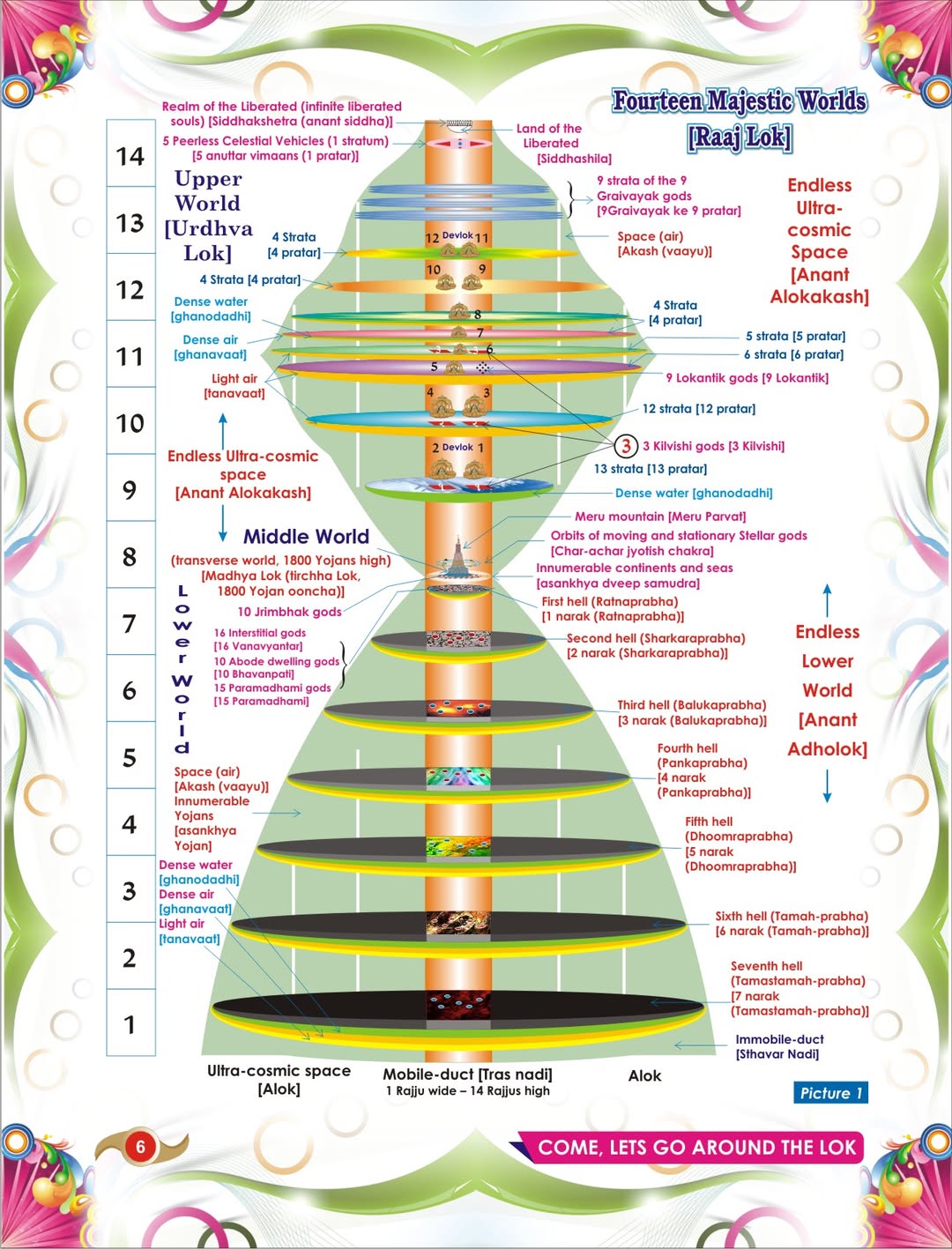
Chapter 3 · Structure of the loka
The fourteen majestic worlds (raaj lok): the seven earths below, the middle world with Jambūdvīpa and Mount Meru, the heavens and the five anuttara vimānas above, crowned by the siddha-śilā, with aloka — endless ultra-cosmic space — beyond (3.1, 3.39, 4.19-4.20).
Chapter 3 · Jambūdvīpa — seven regions
A circular continent with Mount Meru at its navel, cut into seven kṣetras by six boundary mountain ranges (3.9-3.11).
Chapter 3 · The wheel of time
Six descending and six ascending stages (3.30).
Chapter 4 · The four orders of gods
Each with its own hierarchy (4.1).
Chapter 4 · Ascending the heavens
Lifespan, radiance and purity rise; stature, craving and pride fall (4.21-4.22).
Chapter 5 · The six substances
Extended (astikāya), with form (rūpī), and number (5.1-5.6).
Chapter 5 · Utpāda · Vyaya · Dhrauvya
Existence is origination, cessation and permanence at once (5.30).
Chapter 5 · Atomic combination
Snigdha and rūkṣa degrees determine binding (5.32-5.36).
Chapter 6 · How karma flows in
Activity opens the channel; passion makes it stick (6.1-6.5).
Chapter 6 · Cause → karma map
The most practical passage in the scripture (6.11-6.26).
Chapter 7 · Five vows and their bhāvanās
Each vow is stabilised by five contemplations (7.1-7.3).
Chapter 8 · The eight karmas
Four destroy the soul's powers; four shape embodiment (8.4-8.5).
Chapter 8 · Four aspects of bondage
Every bond is fixed in four respects (8.3).
Chapter 8 · The fourteen guṇasthānas
The ladder presupposed throughout chapters 8-10.
Chapter 9 · The 57 means of saṃvara
Six headings that stop the inflow (9.2).
Chapter 9 · Twelve austerities
Six external, six internal — the internal rank higher (9.19-9.20).
Chapter 9 · Four kinds of dhyāna
Concentration is morally neutral until it is qualified (9.29-9.30).
Chapter 9 · Twelve anuprekṣās
Reflections to be returned to daily (9.7).
Chapter 10 · The final sequence
From the destruction of delusion to the summit (10.1-10.6).
Chapter 10 · Why the soul stops
Four causes of rising, one cause of stopping (10.5-10.6).